Sunset Riders Game Cheats
- Developer: Konami
- Genre: Arcade/Action
- Originally on: Sega Genesis (1993)
- Works on: PC, Windows
- Editor Rating:
- User Rating: 8.0/10 - 2 votes
- Rate this game:
Konami made hit after hit in the 80s and 90s and one I love is Sunset Riders. The arcade game is fantastic as is the SNES port that was released in 1993, which is pretty damn close to being arcade perfect. Today, I am taking a look at the Sega Mega Drive/Genesis port which was released in 1992. Let me start by saying right away that this is not as good as the SNES version. However, it is still a fun time in its own right and a game I enjoyed playing with my old man back in the day.
How The West Was Won
The game is mostly feature-complete, with a few minor systems still needing to be reworked. Content additions is the main focus of most updates from now until the game’s completion. There is currently content – including still pictures and animations – for 26+ comic-based heroines, henchwomen and villainesses, including. Sunset Riders Cheats and Cheat Codes, SNES. Registration allows you to keep track of all your content and comments, save bookmarks, and post in all our forums.
The story of the game is that you can play as one of two cowboys. In Sunset Riders you can play as Billy or Cormano. The plot of the game is that there are four big bad guys and they are wanted. You want to get them so that you can bring them to justice, but also so that you can get your hands on that sweet reward money.
Like A Saturday Afternoon Western
The presentation of the game is great. Each level feels like it is taken from an old Western movie or TV show and there is a fair bit of variety to them as well. The two main characters are animated pretty well and you can even sneak into a saloon and get it on with a lady, something that was missing from the SNES version.
While I like the visuals, the game has a tremendous soundtrack. It is lacking the voice of the arcade and the SNES. However, the soundtrack really does rock. Sunset Riders makes great use of the Sega sound chip and it has that classic Genesis/Mega Drive sound that we all know and love.
Bury Me With My Money
The gameplay is awesome. Billy has two guns and Cormano has a shotgun type thing. You walk along a 2d plane shooting any cowpokes that dare try and get in your way. You can get upgrades for your gun as you play and these will make you shoot faster. One hit kills you so you always have to be on the lookout for bullets on the screen. One button jumps, another shoots with you standing still and the other button allows you to shoot and move at the same time.
This is quite a challenging game. Getting to the bosses is quite easy, but some of them can be really tough. It is all about learning their patterns and that is part of the fun. If you find a special emblem on a level, you can take part in a mini-game where you are on horseback and you have to collect things thrown from the back of a wagon. No matter if you are playing in single-player or with a buddy, this is a lot of fun to play through. There is also a two-player battle mode which while it is nice they added it, does not offer much fun.
I love Sunset Riders. While the Sega Genesis/Mega Drive version of the game is most certainly the weakest of the three. This is a game that is still a ton of fun to play. It is the kind of game that I love playing through by myself if I am looking for something, I can beat in one sitting. It is also a game that I enjoy playing with my son. While many people will dump all over the Sega version of the game. Even with its imperfections, I still think this is a fun game.
Final Score
Pros:
- Playing as a cowboy is always a lot of fun!
- The game moves at a fast pace
- It looks fantastic
- I enjoy pretty much all of the music from this game
- It is fun in both single and multiplayer
Cons:
- It is missing a fair bit of content in comparison to the SNES and arcade
- Sometimes it can be hard to see a bullet coming at you
Download Links
System Requirements
Processor: PC compatible, P-200
OS: Windows 9x, Windows 2000 Windows XP, Vista, Win 7, Win 8, Win 10.
Game Features:Single game mode
| Sunset Riders | |
|---|---|
| Developer(s) | Konami Gaming |
| Publisher(s) | Konami Co., Ltd. |
| Director(s) | Hideyuki Tsujimoto |
| Composer(s) | Motoaki Furukawa |
| Platform(s) | Arcade Mega Drive/Genesis SNES Nintendo Switch |
| Release | Arcade: September 1991 Mega Drive/Genesis: December 1992 SNES: June 8, 1993 Switch: June 11, 2020 |
| Genre(s) | Run and gun |
| Mode(s) | Arcade Single-player, 2–4 player (co-op) Mega Drive/Genesis 1–2 player (co-op, versus mode) SNES 1–2 player (co-op) Switch 1-4 player |
| Arcade system | Konami TMNT Based |
Sunset Riders[a] is a side-scrolling run and gun video game developed and released by Konami as a coin-operated video game on the JAMMA arcade platform in 1991. The game is set in the American Old West, where the player takes control of a bounty hunter who is seeking the rewards offered for various criminals.
The coin-op version was released in two variants: a two-player version and a four-player version. Home console versions of Sunset Riders were released for the Sega Mega Drive/Genesis in 1992 and for the Super Nintendo Entertainment System in 1993, to a positive reception. An emulated version of the arcade original was released by Hamster Corporation for the Nintendo Switch and PS4 as part of the company's Arcade Archives series.
Gameplay[edit]
The game, which is set in a fanciful version of the American Old West, revolves around four bounty hunters named Steve, Billy Cool, Bob, and Cormano Wild, who are out to claim rewards offered for eliminating the most wanted outlaws in the West. At the beginning of each stage, the players are shown a wanted poster for the outlaw they will face at its end.
Sunset Riders has gameplay that is similar to both Contra and Vendetta. This cooperative shooter can also be played up to two or four players simultaneously, depending on the version of the game. In the two-player version each player can choose which of the four bounty hunters to play as at the start of the game, while in the four-player version each character is assigned to a different control panel. Steve and Billy wield revolvers, Bob carries a rifle, and Cormano uses a double barrel shotgun. The controls consist of an eight-way joystick for moving and aiming, and two buttons for shooting and jumping. The player(s) can jump between higher/lower floors and slide to avoid enemy attacks.[1]
The objective of the game is to defeat a gang of outlaws in eight stages, with a fight against a strong boss character at the end of each. When two or more people are playing, the one who deals the most damage to a stage boss receives the entire bonus for defeating him. Five of the stages are played on foot, two on horseback, and one on a moving train. A bonus minigame is played after the second and fifth stages, in which the player(s) can earn additional points by shooting outlaws as they pop up. After all eight stages are cleared, the game restarts with increased difficulty.
Power-ups and bonus items can be obtained by entering doorways, defeating certain sack-carrying bandits, or opening sacks placed on the ground. Two power-ups are available, a gold sheriff's badge that grants fully automatic fire and a silver one that gives the player a second gun. Both power-ups can be equipped at once. Other weapons that can be used by the player include dynamite carried by female bandits (which must be thrown back before it explodes), hanging rocks/barrels/torches that can be dropped on enemies, and mounted Gatling guns available only in the last stage. An easter egg involves the defeat of the boss in the fifth stage; if Cormano is active at this point, he will catch the boss's sombrero and wear it for the remainder of the game.
One life is lost whenever the player is hit by any enemy attack, trampled by bulls, caught in a fire or explosion, or struck by a rock or obstacle. Any power-ups that a player has gained are also lost. After all lives are lost, the player may continue the game by inserting more credits, but he has a limited amount of time to do so before the game defaults to a game over screen.
Characters[edit]
There are four playable bounty hunters in the game who are out to claim rewards offered for eliminating the most wanted outlaws in the West. In the Sega Genesis version however there are only two playable bounty hunters.
Billy Cool is a bounty hunter who wields a revolver and speaks in a western country accent.
Cormano Wild is a bounty hunter wearing a Mexican poncho and a sombrero who wields a double barrel shotgun. He later wears a red sombrero worn by El Greco after neutralizing him.
Bob is a bounty hunter wielding a rifle who speaks in a southern American accent.
Steve is a bounty hunter who also wields revolvers similar to Billy's, though his bullets from his revolver appear to be more powerful than Billy's own bullets.
Wanted Outlaws[edit]
The outlaws are the recurring bosses of the game as Richard Rose is the final boss at the end of the game.
Simon Greedwell is a rich and greedy outlaw who is the boss of the first stage. He wields a shotgun while ordering his men to deal with the bounty hunters. His last words on death are 'Bury me with my money.'
Snes zelda cheat codes game genie. Hawkeye Hank Hatfield is a rich outlaw who is known to shoot a gun in one hand and the boss of the second stage. Despite his efforts to kill the bounty hunters, he was neutralized.
Dark Horse is a muscular outlaw who rides an armored horse. He is the boss of the third stage. Once he is neutralized by the bounty hunters, the armored horse runs away along with his corpse.
The Smith Brothers are siblings and outlaws who cause trouble inside a saloon owned by a beautiful woman. They are the bosses of the fourth stage, fought immediately after Dark Horse. After the bounty hunters neutralize the brothers, they watch the dance performance of three beautiful women on stage, who then inform the bounty hunters about Richard Rose and his three henchmen.
El Greco is one of Richard Rose's henchmen and a Mexican outlaw serving as the boss of the fifth stage. He carries a shield to deflect shots and a whip. Once he is neutralized by the bounty hunters, El Greco tosses away his red Mexican sombrero. If Cormano is being played, he will catch the hat and wear it in place of his own for the rest of the game.
Chief Scalpem is a chief from the native American tribe, an expert in knife throwing and one of Richard Rose's henchmen, serving as the boss of the sixth stage. Despite his efforts to defeat the bounty hunters, he was neutralized but was soon spared by the bounty hunters due to his younger sister's plea knowing he was following Richard's orders. In the Sega Genesis version, Scalpem serves as the boss of the third stage.
Paco Loco is a hulking outlaw who wields a gatling gun, and is one of Richard Rose's henchmen, serving as the boss in the seventh stage. Once he is neutralized by the bounty hunters, his last words are Hasta la Bye Bye! referencing the T-800's main catchphrase in the 1991 film Terminator 2: Judgment Day. In the Sega Genesis version, Paco Loco serves as the boss of the second stage.
Sir Richard Rose is a rich and elegant outlaw, and the main villain of the series, serving as the final boss of the game. He is an expert gunslinger, using his revolver in one hand, and demonstrating his agility at a fast pace. Upon his first 'death' he reveals he is using a metal plate to cover his chest and avoid injury. After the second phase, he is finally neutralized by the bounty hunters, symbolized by a graphic showing a single rose being destroyed (not shown in the SNES version). In the Sega Genesis version, he serves as the boss in the fourth and final stage.
Release[edit]
Sunset Riders was showcased at the 1991 Las VegasAmusement Expo.[2]Sunset Riders was originally released for arcades in September 1991. Two years later, the arcade version was reprogrammed to two home consoles. The home versions were only released in North America and Europe.
Sega Genesis[edit]
The Mega Drive/Genesis version of Sunset Riders features the most changes made to the game between the two home versions of the game. Out of the four main characters from the arcade game, only Billy and Cormano are featured. The two characters in the Genesis version were given surnames that they originally did not have in the arcade version (Billy Cool and Cormano Wild).[3][4] The controls are identical to the arcade version aside from the addition of two shooting buttons instead of just one: one button allows the player to walk and shoot at the same time, while the other shoot button keeps the character still when pressed down, allowing the player to change their aim only.[5]
Only four of the eight bosses from the arcade version are featured (Simon Greedwell, Paco Loco, Chief Scalpem, and Sir Richard Rose), and each of the four chapters are divided into two stages. Each boss dialogue is worded in a text bubble instead of voiced. The power-up icons have also been replaced as well. Unlike the other versions, the player can cause a dynamite stick to explode by shooting it. To access the bonus stages, the player must collect a Star-shaped item located in either stage of each chapter. The bonus stages also differ from the ones in the arcade version: the player chases after a moving wagon on horseback, while the woman in the wagon tosses bonus coins and extra lives at the player's path.[6][7][8]
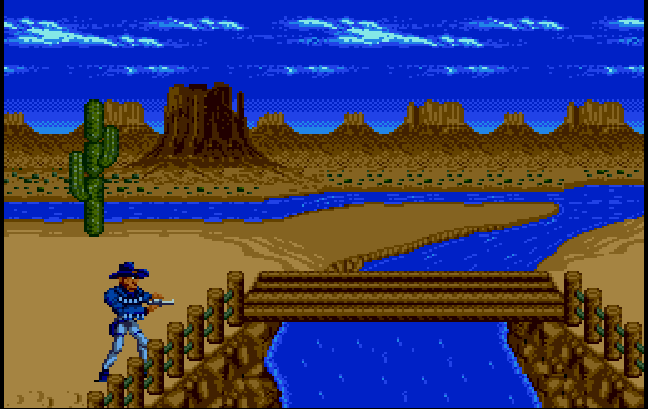
In addition to the standard game mode, the Mega Drive/Genesis version features a two-player versus mode. The players must shoot each other until one of the players runs out of health.[9]
Super NES[edit]
In contrast to the Genesis version, the SNES version of Sunset Riders features relatively few changes. The barfly that kisses the player character in Stage 1 as well as the saloon dancers from Stage 4 are dressed more conservatively compared to the arcade version. Hunter dogs, which were present in the first segment of the final chapter in the Genesis version, were removed. The Native American enemy characters from Stage 6 were removed and replaced with regular outlaws, leaving only Chief Scalpem (who is renamed Chief Wigwam and re-voiced in the SNES game) as the stage boss. The dynamite-tossing female bandits were replaced with male bandits as well.
All boss and cutscene dialogues are subtitled. While most voice clips are carried over from the arcade, some voice lines are either re-worded or replaced with other less offensive lines for censorship purposes.
Arcade Archives re-release[edit]
In March 2020, during the 242nd Arcade Archiver livestream, Hamster Corporation announced a port of the arcade version of Sunset Riders for Nintendo Switch and PlayStation 4 as part of their Arcade Archives banner. It was released in Japan on June 11, 2020.[10] This port is censored, however, with the stage 5 boss, El Greco, saying, “Adios, amigo!” as your battle with him begins, in place of “Die, gringo!”, which he says in the original game. Additionally, the stage 6 boss, originally named Chief Scalpem in the arcade release, is renamed Chief Wigwam. Both of these changes were also present in the SNES port. A Teenage Mutant Ninja Turtles poster that appears during the stage 2 boss fight has also been removed. These changes are present in both the North American and Japanese versions in the Arcade Archives release.
Reception[edit]
Sunset Riders was mostly very well-received by video game press. In Japan, Game Machine listed it on their December 15, 1991 issue as being the third most-successful table arcade unit of the year.[11]Sinclair User gave the arcade game an 82 out of 100, opining it 'plays very well and should prove an interesting challenge for your finely honed arcade skills.'[12] In a more reserved review, Zero rated the arcade original a 3 out of 5, calling it a 'fairly fast shoot'em up with a sense of humour.'[13] The 'rather splendid' SNES version was given an overall score of 87% by Dan Jevons from Super Play, who described it as 'another winner from Konami's stable;'[14] it also received an 88% and an 89% from two reviewers in SNES Force.[15]Hobby Consolas gave the scores of 86% to the SNES version and 78% for the Sega Mega Drive / Genesis one,[16][17] while Mean Machines Sega rated the latter as 84%, noting it as 'surprisingly good'.[18]
Retrospectively, Jamie O'Neill from Nintendo Life awarded this version eight stars out of ten, writing it 'is bright, colourful, fantastically well animated, with superb music and sound. It understands its place as a Western game and within the run-and-gun genre, by combining imaginative characterisation and humour, with well-paced action set-pieces, plus variety in its gameplay.'[19] Retro Game Age gave it the same score as well, opining 'Sunset Riders remains a fun romp that still presents some challenge to get through and is just as fun to play now as it was almost 20 years ago.'[20]IGN ranked it as the 88th best game the SNES.[21] Nick Gibson from Sega-16 rated the Sega Mega Drive / Genesis port a 7 out of 10,[22] while the arcade original was rated 80% by Arcade Attack.[23]
See also[edit]
Notes[edit]
References[edit]
- ^Konami. Sunset Riders (Arcade). Level/area: Operator's manual, page 2.
- ^Cook, John (November 1991). 'Arcades: Konami'. The One. No. 38. emap Images. pp. 94–95.
- ^Konami. Sunset Riders (Sega Genesis). Level/area: Instruction manual, page 3.
- ^Konami. Sunset Riders (Sega Genesis). Level/area: Instruction manual, page 4.
- ^Konami. Sunset Riders (Sega Genesis). Level/area: Instruction manual, page 7.
- ^Konami. Sunset Riders (Sega Genesis). Level/area: Instruction manual, page 8.
- ^Konami. Sunset Riders (Sega Genesis). Level/area: Instruction manual, page 9.
- ^Konami. Sunset Riders (Sega Genesis). Level/area: Instruction manual, page 10.
- ^Konami. Sunset Riders (Sega Genesis). Level/area: Instruction manual, page 05.
- ^McFerran, Damien (June 10, 2020). 'Konami's Cowboy Classic Sunset Riders Is Galloping To Switch This Week'. Nintendo Life. Gamer Network. Retrieved June 11, 2020.
- ^'Game Machine's Best Hit Games 25 - テーブル型TVゲーム機 (Table Videos)'. Game Machine (in Japanese). No. 417. Amusement Press, Inc. 15 December 1991. p. 25.
- ^Sunset Riders review. Sinclair User. December 1991. p. 62
- ^'Zero Magazine Issue 26'. Retrieved 20 March 2016.
- ^'Out-of-Print Archive • Super Nintendo reviews • Sunset Riders'. Retrieved 20 March 2016.
- ^'SNES N-Force Magazine Issue 06'. Retrieved 20 March 2016.
- ^'Hobby Consolas 028'. Retrieved 20 March 2016.
- ^'Hobby Consolas 018'. Retrieved 20 March 2016.
- ^'Mean Machines Sega Magazine Issue 07'. Retrieved 20 March 2016.
- ^Nintendo Life. 'Sunset Riders Review - SNES - Nintendo Life'. Nintendo Life. Retrieved 20 March 2016.
- ^'Sunset Riders (SNES)'. Retro Game Age. 4 February 2011. Retrieved 20 March 2016.
- ^'Sunset Riders'. IGN. Retrieved 20 March 2016.
- ^'Sega-16 – Sunset Riders'. Retrieved 20 March 2016.
- ^'Sunset Riders (Mega Drive Review)'. Archived from the original on 28 August 2016. Retrieved 20 March 2016.
Sunset Riders Game Genie
External links[edit]
- Sunset Riders at the Killer List of Videogames
- Sunset Riders at MobyGames